Do You Think You Can Play in the NBA?
The NBA Draft Combine is the ultimate test to answer that question. Every year, the top college and international basketball prospects are evaluated through physical measurements, athletic tests, shooting drills, and scrimmages. Here you'll find every Combine test and the results considered average, very good, and excellent for each one.
First Impressions: Physical Measurements
Before the athletic testing begins, every participant goes through a comprehensive measurement process. The NBA records height (with and without shoes), weight, wingspan, standing reach, hand size, and body fat percentage.
These measurements allow teams to objectively compare each player's physical profile against NBA standards and help project how well they will translate to the NBA level.
Transition Speed: Three-Quarter Court Sprint
One of the first challenges is the three-quarter court sprint. The player covers approximately 23 meters at maximum speed, a test that measures acceleration and transition speed, two essential qualities in modern basketball.
Benchmarks
-
Average: over 3.30 seconds
-
Good: between 3.15 and 3.29 seconds
-
Very Good: between 3.05 and 3.14 seconds
-
Excellent: under 3.05 seconds
The fastest times usually belong to point guards and shooting guards, although some small forwards also stand out thanks to their combination of size and speed.
Agility: Lane Agility Drill
The Lane Agility Drill evaluates a player's ability to change direction quickly around the paint, providing an excellent indicator of defensive mobility, especially for perimeter players expected to defend multiple positions.
Throughout the test, the player must keep their face directed toward the baseline. This means that during two sections of the course they must move backward without turning their body. During the lateral movements, the legs cannot cross; the movement must be performed using defensive slides while maintaining a defensive stance. If the player crosses their feet, the test is ruled invalid.
Benchmarks
-
Average: over 11.30 seconds
-
Good: 10.90 to 11.29 seconds
-
Very Good: 10.50 to 10.89 seconds
-
Excellent: under 10 seconds
Lateral Quickness: Shuttle Run
The Shuttle Run requires accelerations, stops, and changes of direction over short distances. It is an especially useful test for evaluating a player's defensive ability, explosiveness, and reaction speed in confined spaces.
The player starts in the center of the line, between the two inner cones. At the evaluator's signal, the side on which the player must begin the drill (left or right) is indicated. From that position, the player performs a defensive slide to the corresponding outer cone, where one foot must step outside the lane line before changing direction. The player then slides laterally to the outer cone on the opposite side, repeating the same action. Finally, the player returns to the center, and the time stops the moment they cross the center line.
Throughout the drill, the player must execute every change of direction with control and maximum speed while maintaining an athletic stance that allows for efficient acceleration and deceleration.
Benchmarks
-
Average: over 3.30 seconds
-
Good: 3.15 to 3.29 seconds
-
Very Good: 3.00 to 3.14 seconds
-
Excellent: under 3.00 seconds
Explosiveness: Standing Vertical Jump
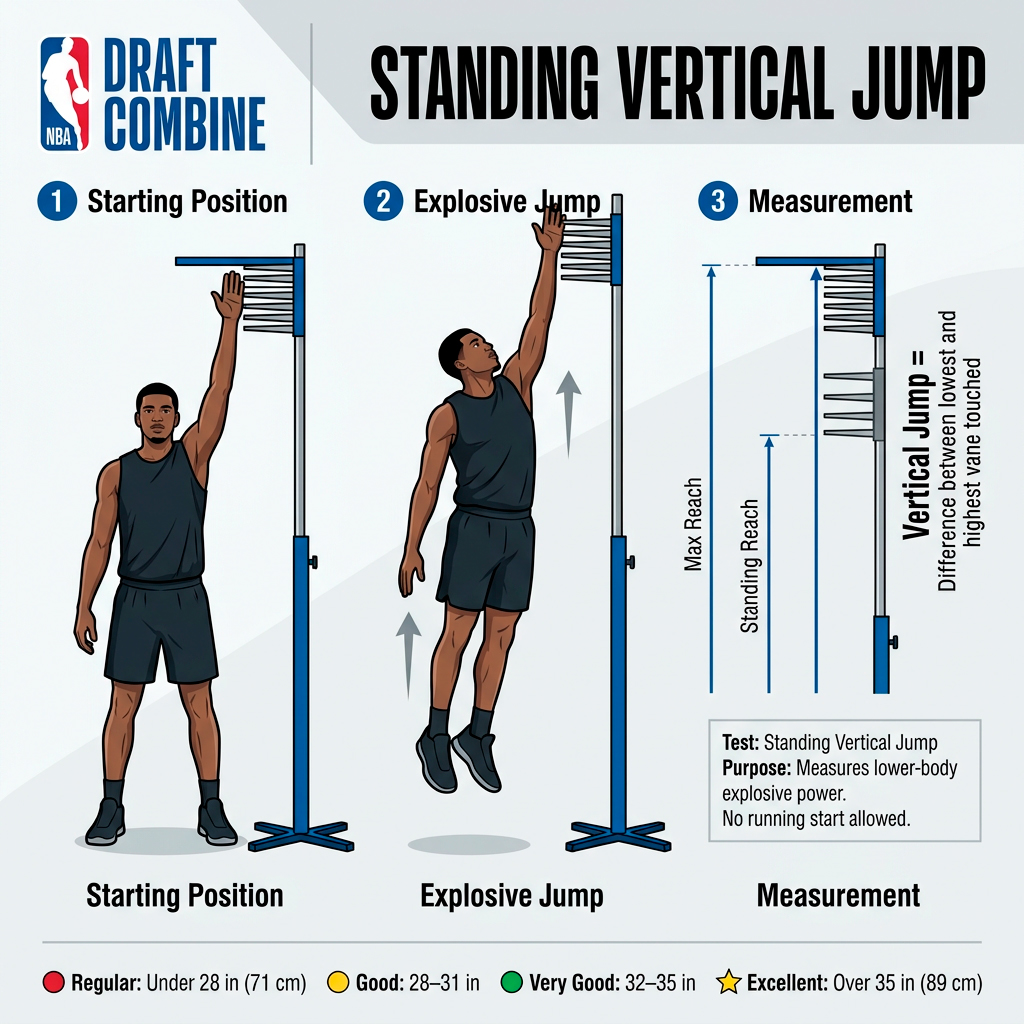
The standing vertical jump measures pure lower-body power from a completely stationary position.
A good result generally translates into greater ability to grab rebounds, finish around the rim, and protect the basket.
Benchmarks
-
Average: under 28 inches (71 cm)
-
Good: 28 to 31 inches
-
Very Good: 32 to 35 inches
-
Excellent: over 35 inches (89 cm)
Maximum Power: Max Vertical Leap
Unlike the standing vertical jump, this test allows players to take a running approach before takeoff, showcasing their maximum explosive ability.
The best Combine athletes typically exceed 42 inches in the max vertical leap.
Benchmarks
-
Average: under 34 inches
-
Good: 34 to 38 inches
-
Very Good: 39 to 42 inches
-
Excellent: over 42 inches (107 cm)
Strength: Bench Press
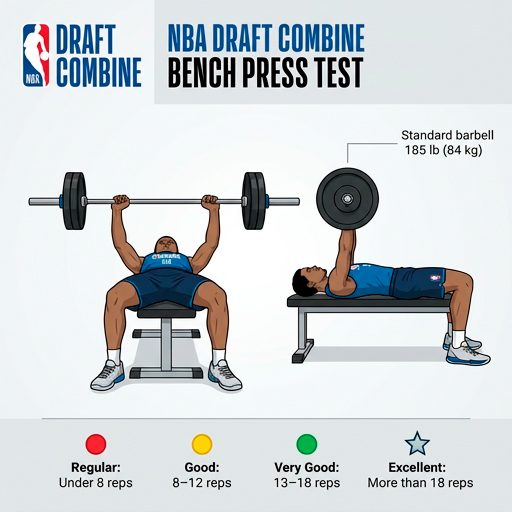
Although not every participant completes this test, the bench press remains an indicator of upper-body strength.
The objective is to complete as many repetitions as possible with 185 pounds (84 kg).
Benchmarks
-
Average: fewer than 8 repetitions
-
Good: between 8 and 12
-
Very Good: between 13 and 18
-
Excellent: more than 18 repetitions
The Most Closely Watched Category: Shooting Drills
Three-Point Shooting
The player must begin the drill from one of the corners of the court. At each shooting spot, they must attempt 5 consecutive shots before moving to the next location. Once the five attempts have been completed, the player moves to the next spot following the designated sequence until all shooting locations have been covered.
The objective of the drill is to evaluate shooting consistency, the ability to maintain stable shooting mechanics, and accuracy from different areas around the perimeter.
Benchmarks
-
Average: 9–11 / 25 (36–44%)
-
Good: 12–14 / 25 (48–56%)
-
Very Good: 15–17 / 25 (60–68%)
-
Excellent: 18–20+ / 25 (72–80%)
Off-the-Dribble Shooting
The player must attempt 5 shots after one dribble to the right and 5 shots after one dribble to the left from each of the three designated positions: both wings beyond the three-point line and the top of the key.
The drill begins from one of the designated spots, completing the shots in both directions before moving to the next location. In total, the player attempts 30 shots (10 shots from each position).
This drill evaluates the player's ability to create their own shot, maintain balance while moving, and preserve consistent shooting mechanics after creating separation with the dribble.
Benchmarks
-
Average: 11–13 / 25 (44–52%)
-
Good: 14–16 / 25 (56–64%)
-
Very Good: 17–19 / 25 (68–76%)
-
Excellent: 20–22+ / 25 (80–88%)
Star Drill
The player must begin from one of the corners beyond the three-point line. Upon receiving the ball, they attempt a three-point shot from that position. After the shot, they move to the next designated spot around the perimeter, where they receive the ball again and repeat the shot.
The player continues the sequence until completing the 5 shooting positions around the three-point line. Once a full circuit has been completed, they begin again from the first position.
The drill consists of 5 complete circuits, for a total of 25 three-point attempts. This test evaluates the player's ability to shoot quickly, adapt to different perimeter positions, and maintain accuracy under fatigue.
Free Throws
Although it is the simplest test, it remains an important indicator of shooting mechanics.
The best shooters at the Combine typically exceed 90% accuracy.
Benchmarks
-
Average: 9–11 / 25 (36–44%)
-
Good: 12–14 / 25 (48–56%)
-
Very Good: 15–17 / 25 (60–68%)
-
Excellent: 18–20+ / 25 (72–80%)
Beyond the Numbers
The NBA Draft Combine does not end when the physical testing is over. The five-on-five scrimmages allow executives to evaluate aspects that cannot be measured with a stopwatch or a measuring tape.
Decision-making, basketball IQ, defensive communication, competitiveness, and the ability to adapt to different roles often carry just as much weight as an outstanding vertical leap or an exceptional sprint time.
Personal interviews and medical evaluations complete a process that provides franchises with a comprehensive view of every prospect.
How Important Is the Combine, Really?
A strong performance at the Combine can significantly improve a player's draft stock and make them a more attractive option for NBA franchises. However, teams still consider regular-season performance to be the primary indicator of a prospect's potential.
For that reason, the Combine should be viewed as a tool to confirm strengths, answer questions, and uncover physical attributes that can make a difference at the highest level.
Every extra inch of wingspan, every tenth of a second in a sprint, and every made shot is part of a much broader evaluation whose ultimate goal is to answer one question: is this player ready to compete in the NBA?